 Itamar Assaf
We all grew up on the same contract: study, work hard, specialize in one thing, and eventually you get to be free. Most people I meet in the community still run their careers by it, even when they feel the ground moving. Roei Livne, an entrepreneur for 14 years, thinks that contract is broken. What replaces it, in his view, is not more specialization, but an AI orchestrator career: moving from someone who produces output to someone who runs the tools, connects disciplines and takes ownership of their own fate.
An Entrepreneur Between New York and Tel Aviv
Roei is 43, lives in Tel Aviv, is married to Roni, and when I asked him about the one hat above all others, the answer was simple: "Being Adam's dad." Only then did we get to business.
He founded companies in two fields: autonomous code conversion and demand forecasting in supply chain management. He works mainly in the US, in New York, and sold his share in those companies. In between, he helped the army with its LLM system, and then founded influenceai.ai.
His current company works on the chat engines themselves. Brands use it to monitor and correct distortions in chat engines like ChatGPT and Gemini, making sure what users get about the company and its products is accurate and presents it favorably.
What Pirates Teach About Personal Sovereignty
The theme Roei keeps coming back to is sovereignty. And his image doesn't come from management books, but from the sea. "People see pirates as nothing but robbers," he says. "I see sovereignty, and a society that existed outside the norm, but was the first to bring real liberal values and a kind of democracy."
On the ship, he explains, the captain is elected by the crew and replaced if he doesn't meet expectations. The loot is shared among everyone who took part. For him it's no accident that people are drawn to Jack Sparrow: "In today's world, only the brave and the free manage to rise above the mentality of survival and scarcity. There's no point believing the systems will protect us. We have to take our fate into our own hands and be brave."
That's a hard sentence to hear. Most of us believed the job of organizations and systems was to look after us. Roei met that doubt early, at home. His father, a civil engineer, was in his words "an entrepreneur at heart who didn't believe in walls, only in creating and building."
When Trust in the System Breaks
Curiosity led him to study how money and systems work, something he finds strange that nobody teaches in school. His conclusion is sharp: systems work as long as people trust them, and in recent years that trust has broken.
His example comes from home: "My mother always told me, look how much our house is worth now. And I tell her, look how much your purchasing power has dropped. If you sold the house, could you upgrade to a better one?"
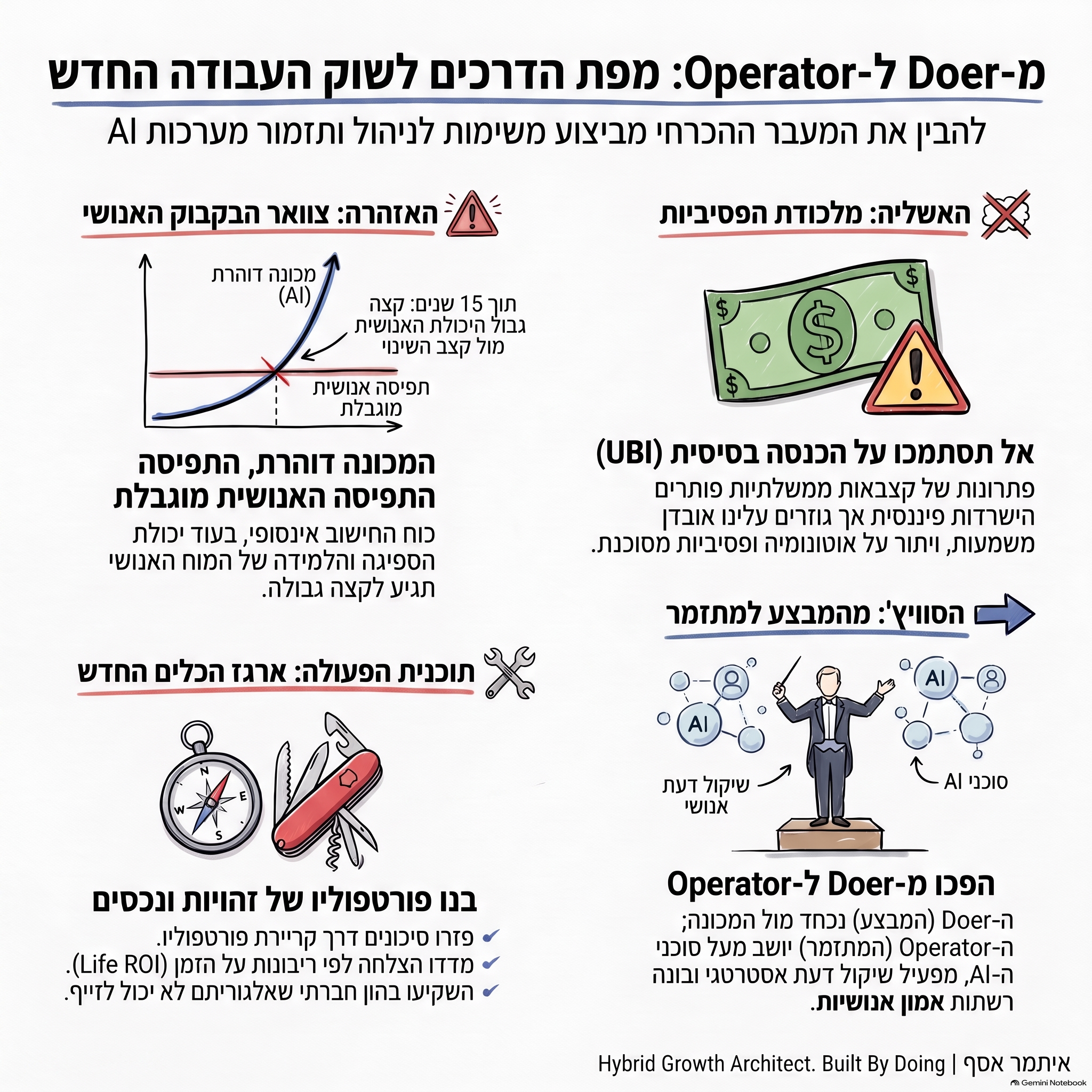
And into all of this comes AI. "The output of AI is so relatively cheap that it enables almost infinite value creation at low cost. Systems built to preserve scarcity don't fit that." The value barrier today, he says, is measured by how much electricity can be produced.
From Doer to Hybrid Orchestrator: The Step for Tomorrow Morning
I asked him what the first step should be for any reasonable person tomorrow morning, so as not to become redundant in the face of AI. He gave two. The first: "Learn to operate these tools well. Make AI your best friend."
The second is harder: deepen your skills across several fields at once. "If I'm a CEO, I need to know sales really well, customer service and product really well. It's a shift in mindset, because we all grew up on specialize and don't do both." On age, he is blunt: "In the context of AI, age has no meaning. Only mental flexibility matters."
For employees aged 50 and up in the community, his recommendation was clear: diversification as risk spreading. Learn something adjacent to your core work that gives broader value than a narrow departmental view. "If until now I've been dealing with output, from now on I need to think like a manager, a manager of AI." Their experience isn't a burden, it's the foundation: broad knowledge that enables multi-system solutions, and value that is hard to replace.
This is where I added what I write about all the time. A portfolio career, the both-and model, can be an additional side pursuit, or a new skill inside your current job. These systems will take some of our capabilities, and we will need to reinvent ourselves and not depend on one thing.
Depth in an Era When Anyone Can Build a Demo
When AI cuts the cost of resources and anyone can build a POC over a weekend, the question is what's hard to copy. Roei names three sources of business depth: a deep understanding of human needs, because "in the end, solutions serve people only." Looking ahead and building solutions for the problems of the next six months or year. And a relative advantage in a niche, which at his company takes the form of data that isn't available outside the solution they provide.
He suggests a simple exercise: look at your phone and ask whether there will still be apps in a few years, and who will visit a company's website to learn about its services. "These are not hard questions to answer."
And what about a versatile founder who looks scattered to investors? Roei went back to his father, who once told him in a moment of candor: "I envy you, you have the ability to learn so many things in parallel." His answer for investors: a founder first needs to understand their own field in depth, but also everything else that will get them to the goal. "Honesty and confidence about the limits of your knowledge is the real power, and smart investors know how to appreciate that."
The Walls That Taught, and the Fear of Losing Sovereignty
Would he do anything differently? "A lot. But I believe the path is the learning, and without learning there's no success. George Washington didn't win a single battle in his life, but he won the war."
In the rapid-fire round, he picked Marcus Aurelius's Meditations as the must-read for every modern pirate. When he needs to make time for himself, he goes somewhere he can be alone and meditates. And what scares him most about AI? "That we'll lose ourselves to technology and lose our sovereignty."
What Roei Is Looking For From the Community
Roei is looking for people, not just ideas. "I'm interested in entrepreneurship and ideas from smart people with an energy of doing, who see the changes and say this is the opportunity of a lifetime, the kind that doesn't come even once a decade. Who understand that movement and action are the way forward." If you are working on an idea like that, or know one founder standing at exactly that junction, send him a message this week.
More conversations like this one: all interviews and articles from the Lost in Y blog.