 Itamar Assaf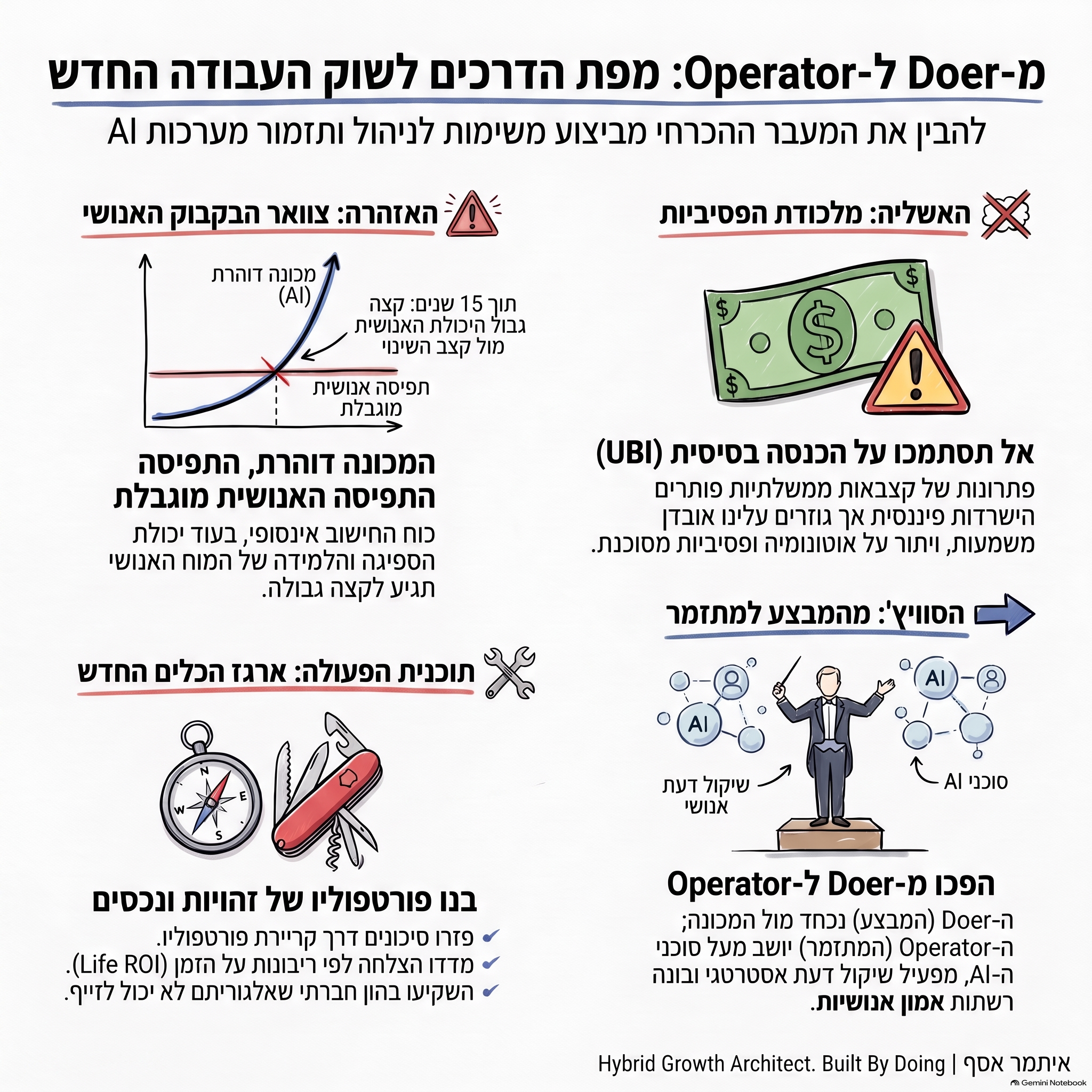
Rosh Hashanah is behind us, and it's a good time to take a clear-eyed look at reality.
This week, something unusual happened at the top of AI companies. The reason this is so significant is that the warning cry is not coming from politicians or journalists, but from the very people who are building the machine themselves.
On one hand, Anthropic CEO Dario Amodei issued a public call to put on the brakes and regulate the pace, understanding that things are starting to get out of control. On the other hand, a senior OpenAI researcher resigned and warned that companies are rushing towards superintelligence without taking responsibility. When the architects themselves say the technology is moving too fast,
we understand that the impact on our lives and the job market is not a futuristic theory. It's happening right now.
Recursive AI Economy and the Two Horizons
To understand why this process is accelerating so rapidly, it's worth getting familiar with the 'Recursive AI Economy' model from a recent thought experiment published under the title 'Two Horizons'. Normally, intelligence is treated as a resource to be acquired. In a recursive economy, it's an input that helps produce more of itself.
AI helps design smarter chips and optimize algorithms, resulting in a reinforcing feedback loop that accelerates development at an unprecedented pace.
This model defines two horizons that run in parallel:
The Mathematical Horizon (Singularity): A theoretical state where each doubling of models' capabilities takes less time than the previous one, leading to a surge in a very short period.
The Human Horizon: While machines can improve indefinitely, our attention, free time, and ability to implement results remain constant. There's a glass ceiling to the amount of practical benefit a person can absorb.
From a simulation examining a 'middle-ground scenario', it appears that by January 2038, we will need systems 38 times more powerful than what we have today to reach 95% of the 'utility ceiling'.
The real bottleneck in the coming years is not computational power, but our capacity for absorption and orchestration.
The Illusion of UBI and the Shift to Orchestrator
Faced with this picture, many cling to the solution of 'Universal Basic Income' (UBI).
In my opinion, this is an illusion. Basic income might cover financial survival, but it won't solve the deep human need for meaning, creativity, and autonomy.
Reliance on stipends or similar incomes will condemn us to a passive life, while a small elite holds all the power and orchestrates the systems.
The job market is changing shape, and the technical execution layer is steadily disappearing. Those who remain relevant will be the ones who switch from being a 'Doer' to an 'Orchestrator'.
We no longer need to compete with machines for the mundane tasks. Instead, we must sit above AI agents,
exercise strategic judgment, and, crucially, build social capital, connections, and trust networks that no algorithm will ever be able to fake.
Now is the time to diversify risks and build a portfolio career with several anchors simultaneously.
Measure every opportunity through its Life ROI to regain control over our time. Nothing will happen from theories alone; we need to get hands-on experience.
The machine may perform the work, but it is the human who must stay at the helm and determine the direction.