 Itamar Assaf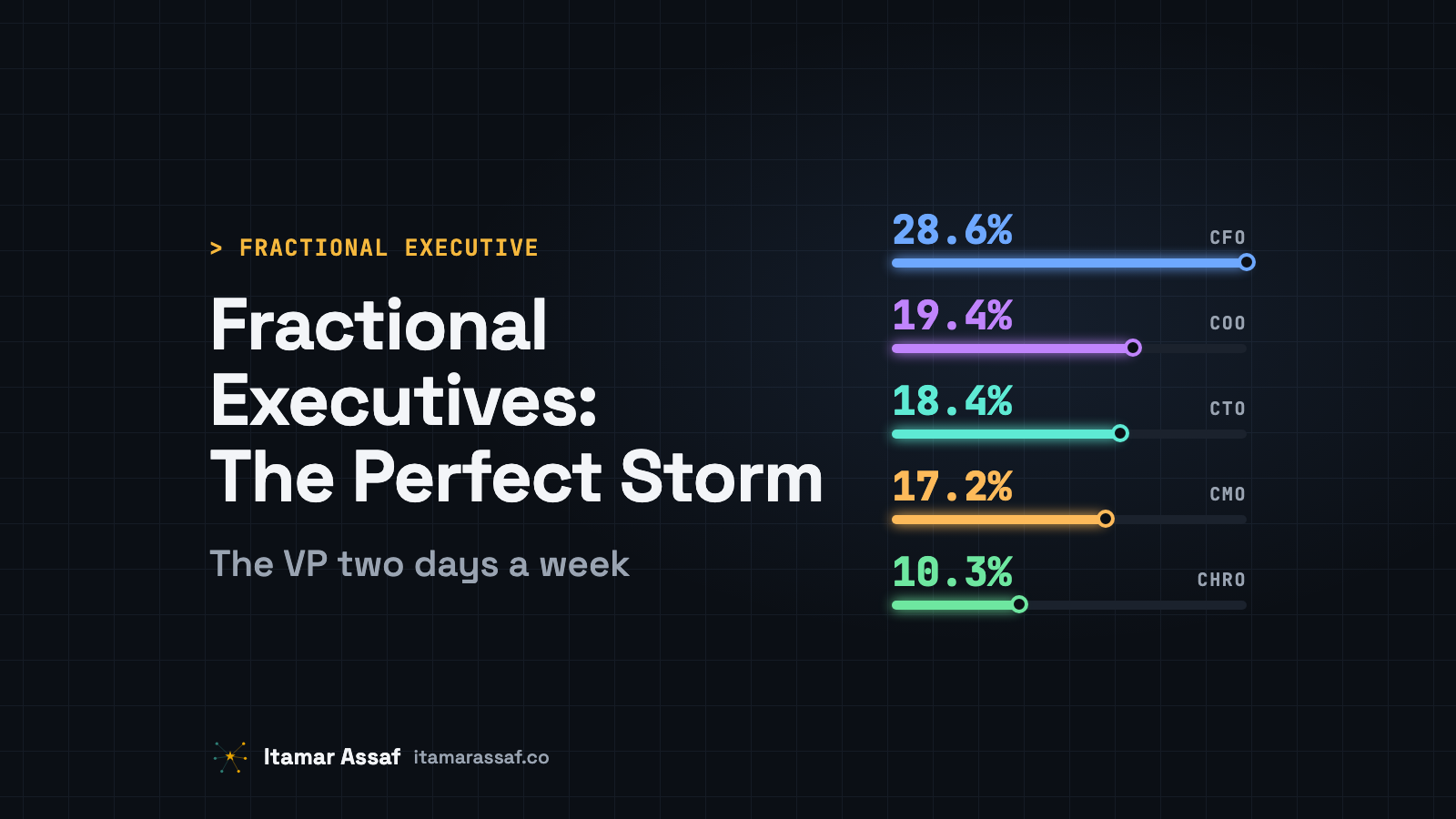
A veteran manager at a tech company told me recently: "The salary is good, the car is good, and I feel like I'm waiting for the next round of cuts." The same week, a startup CEO told me he needed a VP of Marketing but could not afford a full-time one. Those two sentences are the same problem seen from both sides, and the answer to both is the fractional executive. To understand why this model doubles every two years, you have to see the storm that created it: unbossing, the end of the linear career, the portfolio career and the community economy. Here is each one, with the source behind it.
Unbossing: The End of the Linear Career
The dominant global trend is the flattening of organizational structures and the dismantling of the middle-management layer. Large companies are cutting thousands of staff positions because coordination, control and reporting are now done efficiently by AI tools. Deloitte asks the question outright in the title of its 2025 Human Capital Trends report: Is there still value in the role of managers? and describes organizations flattening hierarchies and leaning on AI instead of middle managers.
Fast Company adds the other half of the picture: entry-level hiring is slowing, management is shrinking, and the person squeezed in the middle is the mid-career professional. This is not a Silicon Valley story. From London to Tel Aviv to Singapore, the same pattern repeats: work is not disappearing, it is changing, and the change will reach most of us by 2030.
This is where zombie employment is born. Veteran employees and managers, especially those over 40, are trapped in well-paid roles that have lost their technological or operational core. A golden cage: a salary that is hard to leave, a role that has been hollowed out, and waiting for the next wave without building new skills.
Meanwhile, from below, Gen Z is recoiling from traditional management roles. Academic research on Gen Z calls it Conscious Unbossing: they identify the role as a center of stress and burnout without matching reward, and prefer professional influence over hierarchical authority. When the young do not want the chair and the organization does not need it, the old promotion path simply evaporates.
The Fractional Executive: A VP Two Days a Week
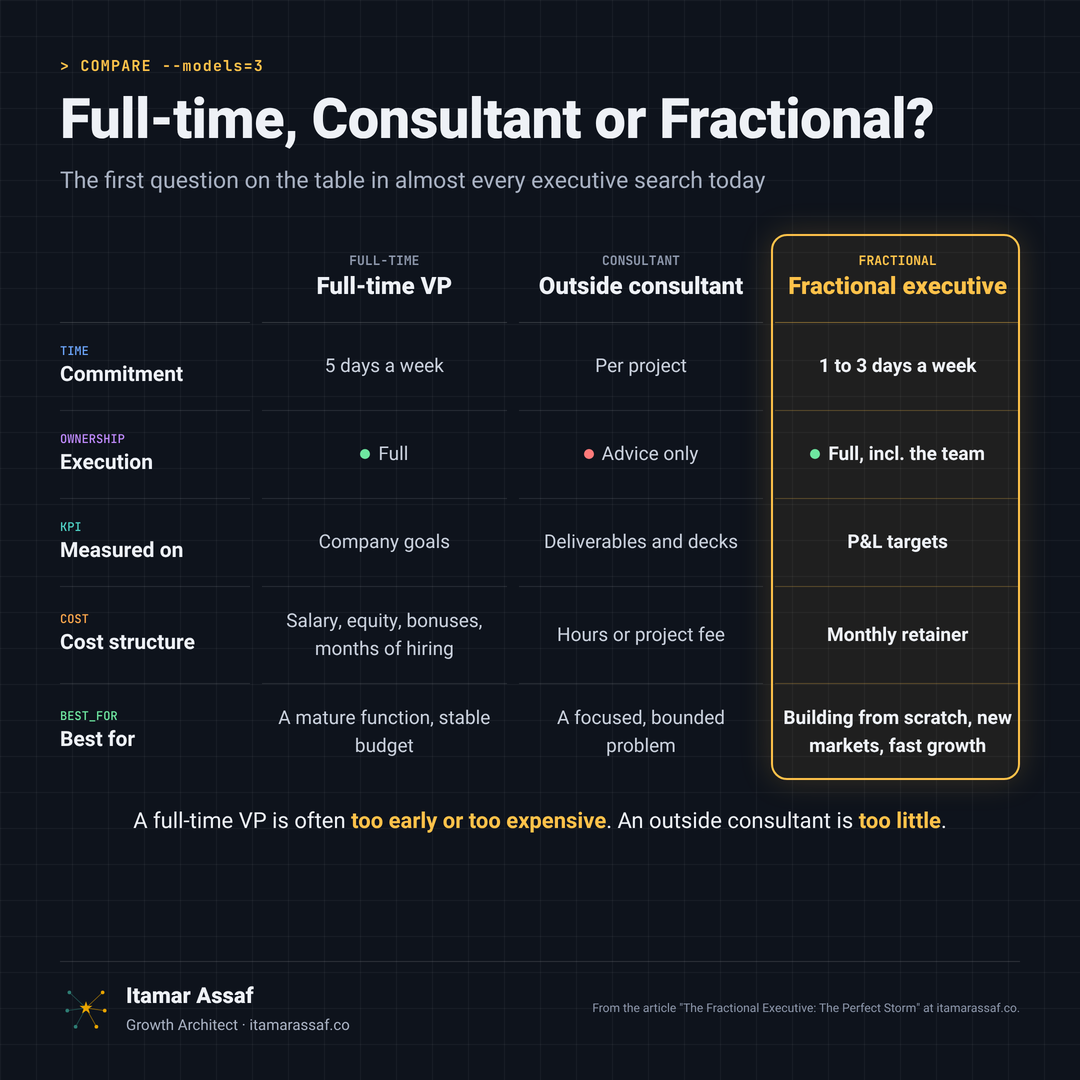
As a mirror image of the change among workers, organizations are changing their employment model too. Companies understand that they do not need, and sometimes cannot afford, the cost of a heavy full-time leadership team. That is how the fractional executive model was born: a very experienced senior leader who works one to three days a week on a monthly retainer. Unlike a classic consultant, a fractional executive takes full operational ownership, manages teams and is measured on P&L targets.
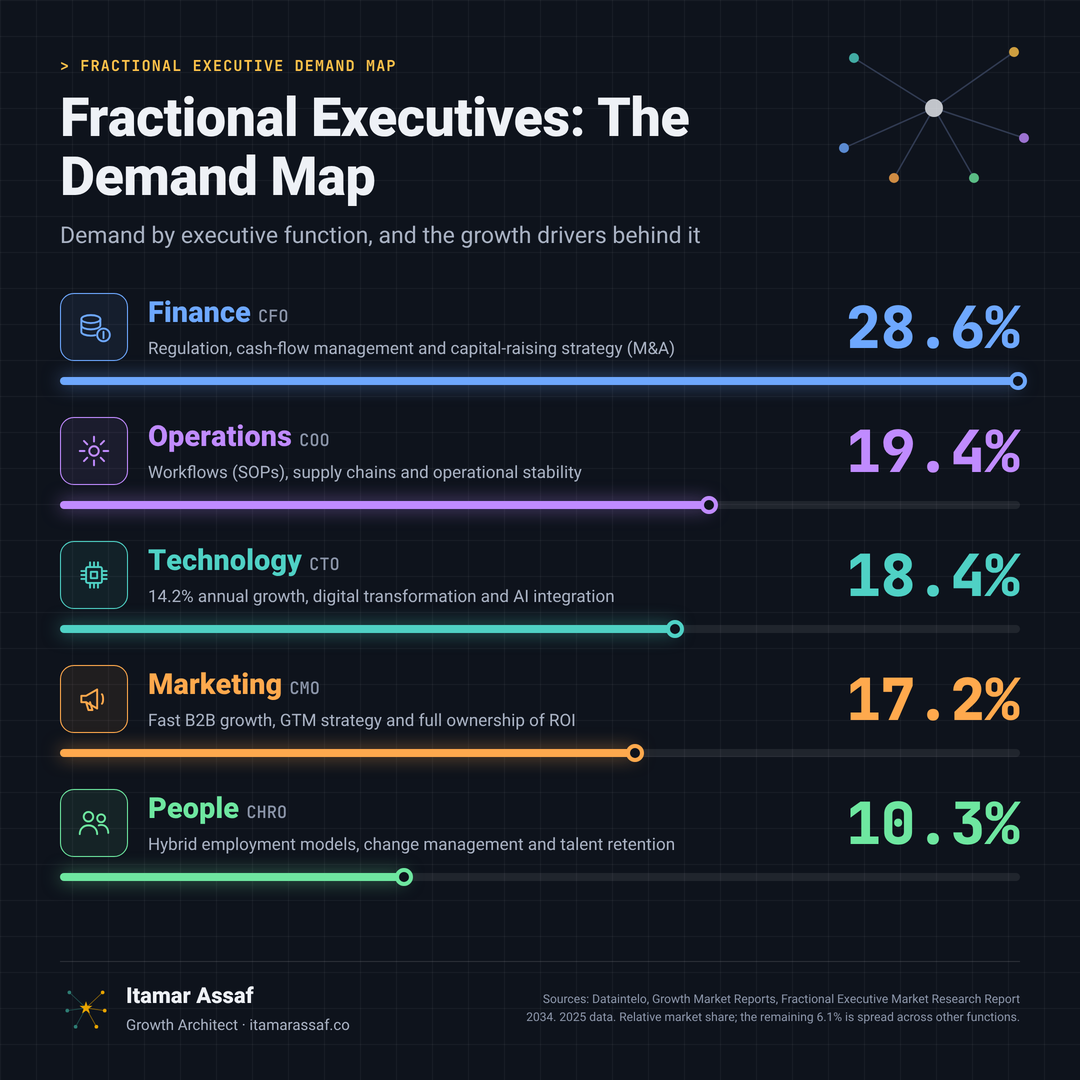
The growth is exponential. According to Fractionus, the number of professionals who define themselves as fractional jumped from 60,000 in 2022 to about 120,000 in 2024, doubling in two years. Dataintelo's market report values the global market at 9.4 billion dollars in 2025 and projects it to reach 24.7 billion dollars by 2034.
What ties this to AI? Fractional C-Suite points to the direct link: as execution becomes more efficient through AI, organizations need fewer hands and more senior judgment, but not full time. For startups and mid-sized companies this is a huge saving compared with a full-time executive, salary, equity and bonuses, while getting a leader who takes ownership of the system and drives complex processes: fundraising with a fractional CFO, international expansion with a fractional CMO.
Who the Fractional Executive Is For
On the company side: a post-product-market-fit startup that needs to build marketing or finance from scratch, a mid-sized company growing faster than its leadership team, or an organization entering a new market that needs someone who has already done it. In all of these a full-time VP is too early or too expensive, and an outside consultant is too little.
On the executive side: this is a model for senior people with a proven record, not an entry point for beginners. Someone who has led an entire function, built a team and been measured on results can deliver the same value to two or three organizations in parallel. For them the fractional role is not a compromise after a layoff, it is the first anchor of a portfolio career. In most of the executive searches I run today, this is the first question on the table: full time, or fractional.
The Portfolio Career and Life ROI
The worker's answer to the collapse of job security is the portfolio career: several income sources, roles or professional identities in parallel, instead of relying on a single employer. An article on Medium puts it sharply: the portfolio career is the only safety net left in 2026. In the current environment, dependence on one income source is a strategic risk, and a mix of fractional work, entrepreneurship and professional services is a safety net against shocks.
This is not just a bloggers' idea. Research from King's College London built a grounded theory of portfolio working: how people actually assemble it, manage its uncertainty and find meaning in it. And Neurobloom connects the model to multidisciplinary people, lateral thinkers who do not fit a single box, including the link to ADHD: for them the portfolio is not a compromise but the natural structure.
The metric changes accordingly. The old model worshipped financial return alone. The new model aims to maximize Life ROI: a weighting of quality of life, autonomy, satisfaction and free time alongside income. It is a shift from trading hours to trading value.
And the era of narrow expertise is over. Future organizations will need a multi-hyphenate orchestrator: an experienced professional who does not perform routine tasks, AI does those, but manages, supervises and connects the algorithms' work to business strategy. From doer to orchestrator, that is the whole shift in one sentence.
Building a Business Community and Growth Architecture
When the labor market becomes distributed and automated, the real competitive advantage left for professionals and companies is the ability to create long-term human trust. Companies understand that customer acquisition costs in paid advertising are becoming less worthwhile, and consumers have developed deep skepticism toward corporate messaging. Watchers.io and Club.co describe the shift from paid advertising to Community-Led Growth: growth based on nurturing a community where customers, partners and experts share knowledge around a shared identity.
The business result is measurable. An active community generates loyalty, reduces churn and serves as a warm, organic pipeline for leads. A study published on ResearchGate shows how a community acts as a catalyst for market entry, a go-to-market tool and not just a service tool. I see it from the inside in the Lost in Y community of more than 3,500 managers and founders: most of the business connections I make start there, not in a campaign, and the same logic holds whether the community sits in Tel Aviv, Berlin or Austin.
Within this reality a new role was born, the growth architect. A holistic figure who does not work in silos but combines market-entry strategy, talent recruitment in flexible models, executive search and fractional executives, and leverages communities into networks of trust and commercial growth. The four forces I described point to the same profile, and it is the profile I recommend every manager over 40 start building while still employed.
The first step is small. Pick one asset you have and have not used: an expertise you could sell two days a week, a community you already belong to, or a relationship you have not cultivated. Write to me what it is, and we will think together about how it becomes your second anchor.
More conversations like this one: all interviews and articles from the Lost in Y blog.