 Itamar Assaf
Will your company's next VP also be working for three other companies at the same time? Until recently that sounded like an edge case. Today it is becoming a hiring model for senior executives.
More companies want access to serious leadership experience without committing to a full-time role. And more executives are exploring how to turn decades of experience into work with several organizations at once. Part-time executive roles are moving from an exception to a business model.
4,000 conversations and one recurring question
Over the past decade I've had more than 4,000 one-on-one conversations with managers, founders and professionals. In the last two years I keep hearing one question.
Senior people with 20 years of experience or more are asking whether their next career move really has to be another single full-time job. After freelancers and consultants, the flexible-work revolution is now climbing to the top floor of the organization.
What is a fractional executive
The model is called a fractional executive. An experienced leader serves as CFO, CMO, COO or another senior role on a part-time basis, and stays involved in decisions and leadership over time. This isn't a consultant who delivers a deck and leaves.
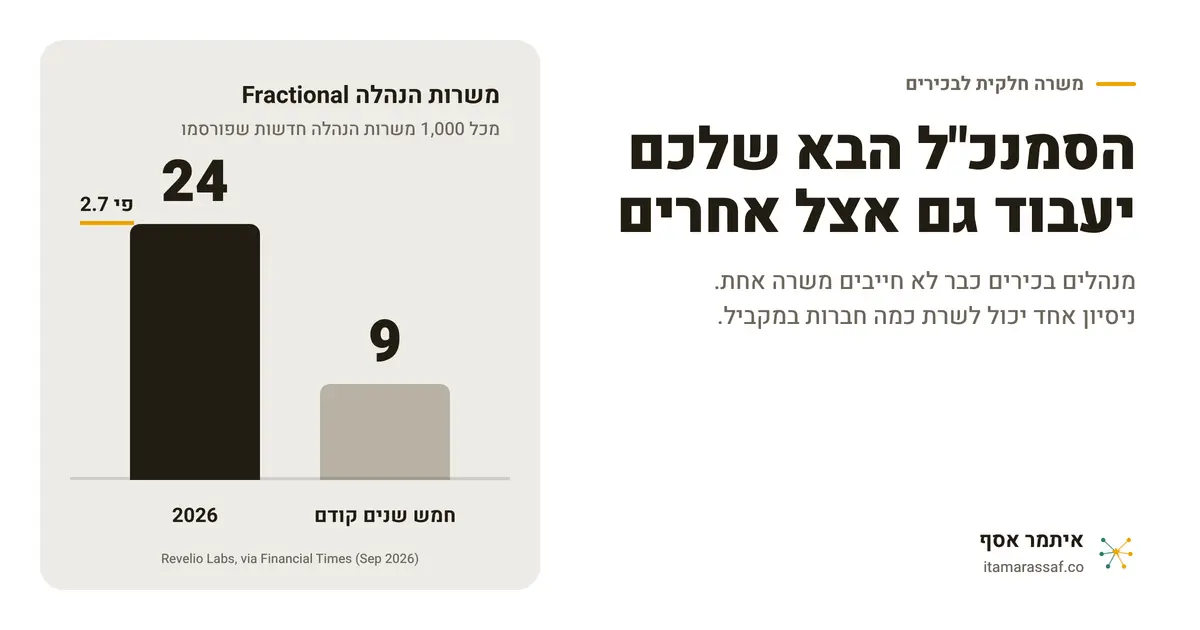
According to a Revelio Labs analysis cited in September by the Financial Times, in the company's 2026 data, 24 of every 1,000 new executive job postings were fractional, compared with nine five years earlier. About 20% were CFO roles, followed by marketing and operations.
Why now
Companies are under more cost pressure, cutting management layers and asking small teams to do more. AI accelerates this, because it lets organizations do more work with fewer resources.
But the need for judgment, experience and senior decision-making hasn't gone away. The cheaper execution becomes, the more valuable senior judgment gets. You just don't always need it five days a week.
Part-time executives: what the company gains
A startup before a funding round may need a CFO who has been through the process, without yet justifying a full-time hire. A company entering a new market may need a senior CMO two days a week. That opens access to experience that would otherwise be too expensive, or simply unavailable.
In finance this is especially clear. An experienced CFO can build a cash-flow forecast, lead negotiations with banks and investors, and review the financing structure. A wrong financial decision can cost the company far more than the cost of hiring them.
I know this from my own side too. As a fractional growth leader, I join companies at the stage when they need to build a marketing and partnerships engine, but don't yet need a full-time VP.
One employer, or several income streams
On the executive side, the change is just as deep. For years, seniority meant deeper dependence on one organization. Salary, title, team and professional identity were all tied to the employer.
Today I see more executives trying to unwind that dependence. They ask questions that were never part of the classic career path: how do you price a senior executive's day, how many organizations can you support at once, and how do you start while still in a full-time role.
This shift also means rethinking job security. Instead of one salary and a single employer, you build work on several clients and several income streams. Spreading out reduces dependence on one organization, but it puts the responsibility for creating opportunities on the executive.
The asset to build before you switch
In most cases, the first fractional role comes through a past connection, a referral or a one-off project, and only later becomes an ongoing relationship. That is why your network and professional reputation are critical assets long before you decide to change course.
This is another stage in the evolution of the portfolio career, a model in which you build several professional anchors in parallel. For experienced executives that can mean a mix of leadership roles, advisory work, boards and projects. If workers are building career portfolios, companies are starting to build talent portfolios.
Flexibility comes with responsibility
The model has a price. A fractional executive has to get up to speed fast, build trust without being there all week, and carefully manage confidentiality and conflicts of interest.
The company also needs to know when part-time expertise is enough and when full-time presence is required. Who is available during a cash-flow crisis, when an urgent financing decision is needed, or when a dispute with an investor comes up? Without clear definitions of authority, availability and accountability, the cost savings will come at the expense of management quality.
The next question for senior executives
After 4,000 conversations, a change is emerging that's hard to ignore. Seniority no longer has to lead to one bigger job. It can become experience that creates value in several organizations at once.
The question for a senior executive won't only be what their next role is, but how many organizations need what they already know how to do.
So if you're there, write down three problems you solve better than anyone else, and three companies that have them today. That's your starting point. And if you want to think it through with people who've already made the move, the Lost in Y community is built for exactly that.
A Hebrew version of this article was first published in Funder.
More conversations like this one: all interviews and articles from the Lost in Y blog.