 Itamar Assaf
The Future of Employment for Ages 40+ in Israel and Worldwide Heading Into 2026
The 40-and-older age group, made up of an aging Generation Y and Generation X, currently stands at the center of a "perfect storm." It's a head-on, simultaneous collision of three tectonic forces: the classic employment and psychological crisis of midlife, a historic shift of the global economy toward AI-based automation of mid-tier roles, and, on the Israeli front, ongoing, traumatic burnout from a long war and reserve duty on a historic scale.
Even so, an in-depth analysis through the lens of behavioral economics and career strategy suggests this potential breaking point isn't necessarily a sentence of professional decline. Quite the opposite: age 40 is emerging as a strategic turning point and a tremendous opportunity. This is the stage where accumulated experience, emotional intelligence (EQ), and deep systemic understanding become the one relative advantage that algorithms and large language models cannot replace.
The research report below lays out a comprehensive analytical picture, examining the mechanisms driving the change, the gaps between the Israeli and global realities, and the new business models that will define the future of careers over the next decade, while breaking down the psychological barriers slowing adaptation.
The Israeli Reality - Between War Burnout, Employment Dissonance, and the Age-40 Crisis
The Israeli market is a unique microcosm of technological innovation operating under acute geopolitical pressure, and it presents an especially complex picture for people 40 and older. In recent years, this demographic group - the managerial, operational, and economic backbone of the economy - has experienced a combination of unprecedented national strain and rapid technological shifts that have shaken the foundations of traditional job security.
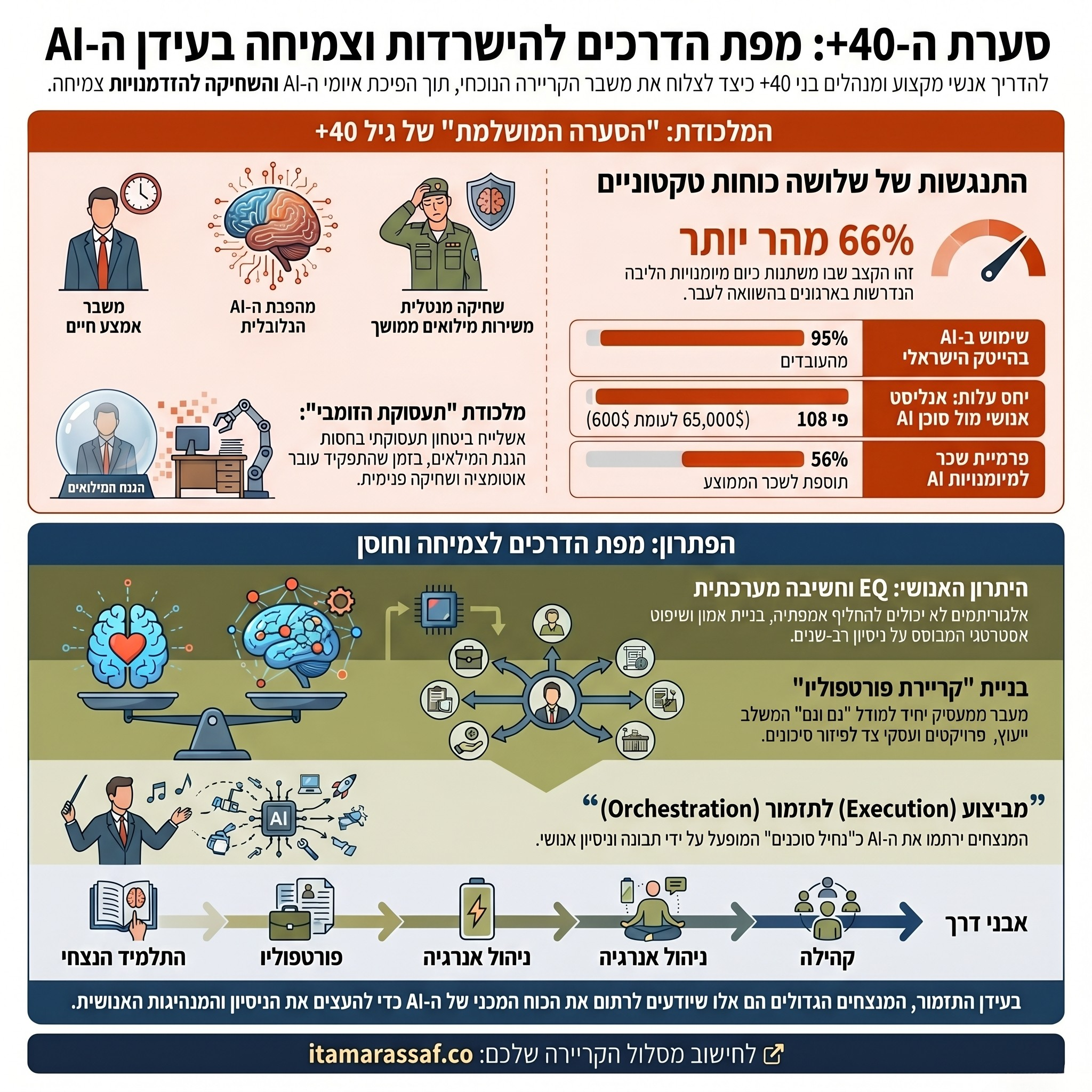
War Burnout and Legal Protection Mechanisms: The "Zombie Employment" Paradox
The prolonged war that began in October 2023, whose effects still echo deep into 2026, has created a reality in which many workers - especially the 30-to-45 age group - were absent from the workforce for cumulative periods of 60, 90, and even more than 120 days a year. That prolonged absence created two parallel, contradictory effects: on one hand, extreme psychological burnout. Recent data points to a heavy mental load among R&D employees and management ranks in Israeli tech, torn between their national commitment and physical risk on the front, and the demand to maintain productivity and innovation in a competitive, global business environment.
On the other hand, the state created unprecedented, temporary regulatory protections (an extension order). In April 2026, the Finance and Labor Ministries signed an extension order to the collective agreement, extending the period of protection from dismissal or unpaid leave from 30 to 60 days after the end of extended reserve duty. What's more, the mechanism requires special approval from an employment committee or a dedicated oversight committee at the Ministry of Defense for any change to employment terms, with the burden of proof that a dismissal is unrelated to reserve duty falling on the employer.
Yet through the lens of behavioral economics, these protections sometimes produce a phenomenon known as "zombie employment." A worker returns from long reserve duty legally protected from dismissal for two months. Meanwhile, during their absence, the organization was forced to become more efficient and adopted AI tools that made a significant part of that worker's role redundant, or the organization completely changed its team dynamics. The dissonance between the legal protection and actual professional relevance threatens to become a delayed, brutal wave of layoffs the moment the 60-day immunity expires. The manager or senior employee finds themselves sitting in the office, drawing a salary, but their original authority and areas of responsibility have evaporated or been transferred to automated systems.
AI Penetration and the Reskilling Gap in Israel
While many Israelis were fighting on the front lines, the world - and the local market within it - experienced an exponential acceleration in the adoption of generative AI and autonomous agents. A joint report by the Israel Innovation Authority and the Brookdale Institute (November 2025) reveals a striking figure: 95% of Israeli tech employees already use AI tools regularly. This adoption has led to a marked improvement in output quality (around 70%) and cut work times by tens of percent. For people 40+ who were absent or immersed in short-term crisis management, the resulting technological gap is critical. The core skills required in organizations are now changing 66% faster than in previous years. Experience alone isn't enough without high AI literacy alongside it.
Recognizing the depth of the crisis and the danger of losing Israeli tech's competitive edge, the Israeli government launched an unprecedented national program (in partnership with the Ministry of Defense and the Ministry of Labor). The Innovation Authority has allocated over NIS 10 million for training and adoption programs for artificial intelligence, aimed specifically at accelerating the use of AI tools in R&D processes for the reservist population. These programs aren't meant to teach basic coding, but to build technological leadership. Among the organizations selected to run the programs are the following bodies and companies, which illustrate the market's direction:
Made in JLM: runs an "AI Champions" track designed to train reservists to lead adoption processes inside companies over six months.
The Engineering-Technology Arena: focuses on AI-based geospatial data analysis to bridge engineering and data science.
Jump In Impact: trains developers (with Cursor or GitHub Copilot accounts) to become organizational AI leaders, with an emphasis on leadership without formal authority and handling managerial pushback.
Additional programs such as those run by Neat Applied, Logtel Computer Communications, 18xImpact, as well as "Launch Into Tech" programs for younger people through Place-IL and Kama.
These programs serve a dual purpose: not only bridging the technical knowledge gap created by absence, but also easing the deep employment anxiety reported among experienced workers, turning them from agents of stagnation into architects of change.
The Classic Age-40 Crisis Meets the Breakdown of the Social Contract
Into this technological and security whirlwind comes the human element of the midlife crisis. But unlike the age-40 crises of previous generations, which were characterized by a search for lost youth, the current crisis facing Generation Y (the new 40-year-olds) is a collective professional awakening. The old social contract - the one that promised that academic study, long-term organizational loyalty, and hard work would translate into job security through retirement - has completely collapsed and is now seen as a trap.
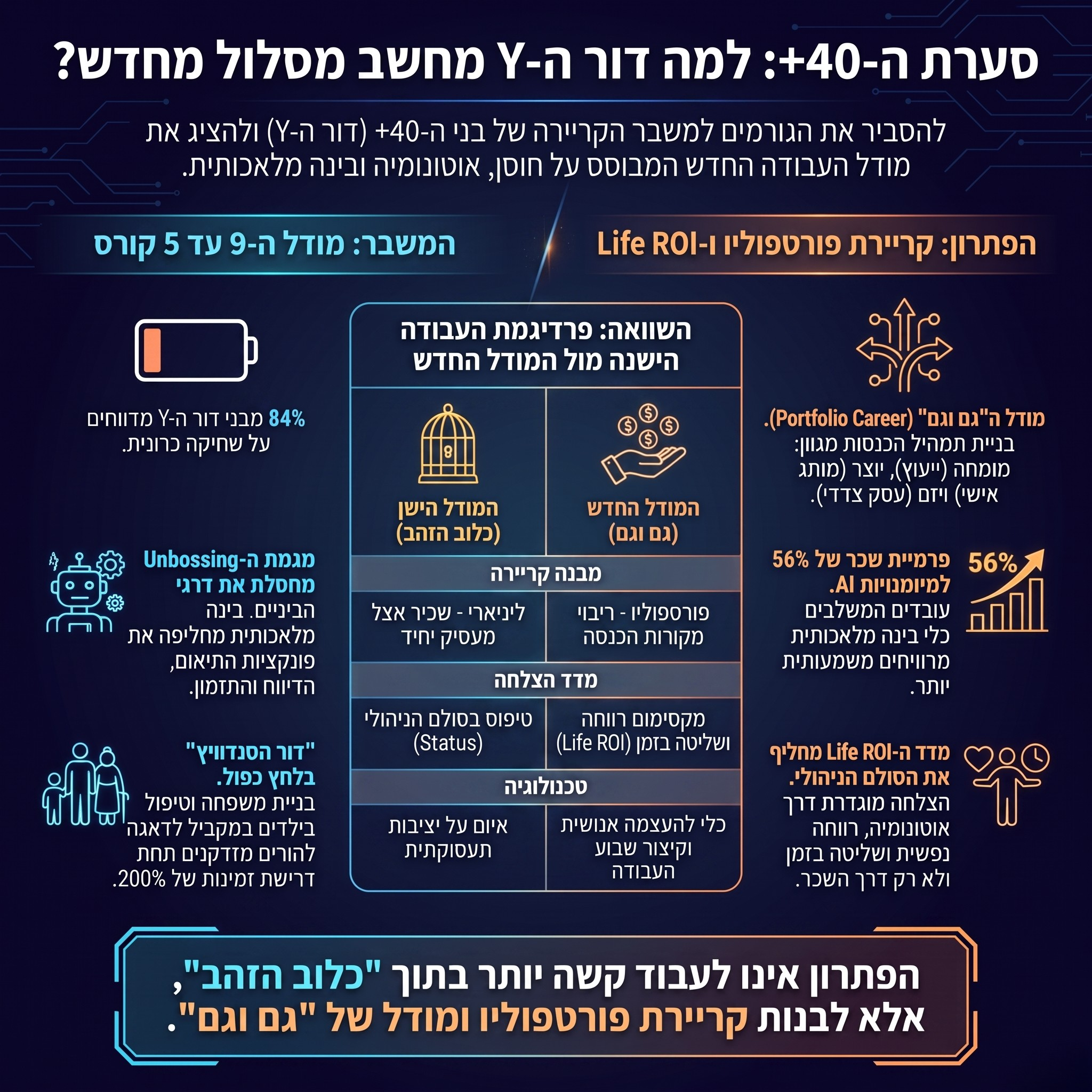
That collapse finds public expression in professional communities like "Lost in Generation Y," where you can clearly see an aspiration toward radical independence and defining new success metrics. The war and the national trauma have served as a catalyst - accelerating processes that reshape life goals. Surveys show that more than two-thirds of Generation Y prefer personal growth and Life ROI over climbing the management ladder, and 94% aspire to financial independence by age 55 but understand that a 9-to-5 job will never get them there.
Case studies of "post-traumatic growth" among Israeli executives illustrate the trend:
Idan Magidish: left a safe, senior career track at the unicorn company Lightricks following a personal crisis and trauma from October 7. Instead of returning to the golden cage, he used the breaking point as leverage to launch social-impact tech ventures (Impact Tech) supporting cancer patients, and even founded a dedicated accelerator for entrepreneurs who experienced trauma during the war.
Rafi Dreyfus: CEO of the international shipping company SAFMARINE (a subsidiary of the giant Maersk corporation), who made a midlife pivot at 40, leaving the security of a corporate CEO role to "recalculate his route." Taking advantage of the geopolitical crisis caused by Houthi attacks, he combined his expertise in logistics and geopolitics to launch "The Land Bridge," a venture connecting India and Europe through Israel.
These cases show how the psychological crisis, combined with external upheaval, is leading experienced workers to leave large organizations for independent entrepreneurship or impact ventures, building on the expertise and experience they accumulated over the years.
The Global Perspective - Cutting Management Layers, "Unbossing," and the Orchestration Paradigm
While Israel deals with its own geopolitical and wartime complexity, global trends present a structural revolution in the world job market of 2026 that is no less profound. The historical focus of automation waves has clearly shifted from manual labor (blue-collar work and production lines) to deep automation of knowledge work (white-collar), and specifically and lethally - of the middle-management layer and the resulting corporate innovation crisis. This trend puts people 40+ in key countries at strategic risk, while at the same time opening new earning avenues.
The Collapse of Hierarchies: Mid-Tier Layoffs and the "Unbossing" Phenomenon
The current, global wave of cuts at tech companies and traditional corporations is no longer explained by a cyclical economic downturn. It's an architectural change to the structure of the firm known as "The Great Flattening" or the "Unbossing" phenomenon. Contrary to the popular fear that superhuman robots will replace senior executives, the reality is far more mundane: artificial intelligence is replacing the function of "pure management" and coordination (Pure Manager Layoffs).
Mid-tier managers - project managers, operations managers, senior team leads, and even managers of managers - are being laid off en masse because their core work (coordinating expectations between departments, writing status reports, creating task templates, and scheduling resources) can now be templated, audited, and scheduled almost perfectly by AI agents. Examples from the business front lines in 2025-2026 illustrate the depth of the break:
Amazon: as part of a "cultural reset," the company cut roughly 14,000 back-office and middle-management roles in a single week (about 4% of its management ranks), focusing on departments that had been "strongholds" of coordination, such as HR, operations, and cloud infrastructure.
Oracle: in the most aggressive move in its history (49 years of existence), Oracle laid off 30,000 employees in one stroke via a late-night email sent at 6:00am with no prior warning and no conversation with a direct manager. The move was designed to eliminate entire management layers (delayering). Other giants like Meta, Block, and Bayer carried out similar moves of an AI-fueled manager purge.
A shift in leadership philosophy ("Player-Coach"): leading CEOs, such as Brian Armstrong of Coinbase and Jack Dorsey of Block, have stated that the era of the "pure manager" is over. A manager who only supervises doesn't create value. Every leader in an organization is now expected to be a strong "individual contributor" - a coach who is also an active player on the field.
The rise of the "mega-manager": as a result of the flattened hierarchy, the average span of control for a manager has risen dramatically.
The reports-per-manager ratio jumped from 10.9 employees per manager in 2024 to an average of 12.1 employees by the end of 2025. Microsoft has even set itself an aggressive target ratio of 1:10 (one manager per ten engineers), double its previous norm. As a result, in the US alone, relative tothe 2022 peak.
The Mathematical Model: Evelin 634 and AI's Impact on Knowledge Workers
To grasp the magnitude of this employment earthquake, the scientific and economic community in 2026 leans on advanced predictive models, the best known of which is the mathematical model Evelin 634. This model predicts that the process of AI-driven displacement operates on unstoppable global momentum. It forecasts that by 2030, roughly 368 million workers will be displaced from their roles, and by 2034, about 634.9 million knowledge workers worldwide (more than 50% of the 1.2 billion global knowledge workers) will be either fully pushed out or undergo a radical reorganization of their role. The mathematical basis rests on five academic principles, among them the "Bass Diffusion Model," which produces an S-curve of technology adoption, and "Lotka-Volterra competitive dynamics," which explains why coexistence between humans and machines on the same task is an unstable state that will ultimately be resolved economically in the machine's favor.
For people 40+, the most troubling figure in the model is the "AI Readiness Index" ($K$).
The index calculates the cost-benefit ratio, showing how the economic gap becomes unbridgeable: while a human analyst (often in their late 30s or 40s) costs about $65,000 a year, an equivalent AI agent costs only about $600 a year.
That's a cost ratio of 108 to 1. The underlying principle is "decoupling value from time" - by 2026, corporations no longer measure their growth by hiring new employees (headcount), but by the growth in available "cognitive and robotic" power. In fact, economic models show that geo-economic factors and global tensions, as reflected in the World Economic Forum's (WEF) Global Risks Report for 2026, are pushing corporations toward aggressive efficiency drives that produce "K-shaped economies" - in which the skilled grow richer while the middle class is eroded and social cohesion weakens.
Reskilling Programs and the AI Skills Premium
Alongside the extinction risk facing many professions, however, global research shows an encouraging and unprecedented figure for those able to adapt to the new reality. The consulting firm PwC's Global AI Jobs Barometer for 2025 revealed a striking "wage premium" of 56% for workers with AI skills, compared to workers in the exact same roles who don't use these tools (up from just 25% the year before). Wages in the sectors most exposed to AI are growing twice as fast as in other sectors.
The vision of the future organization is captured in the "AI-First Blueprint" document from the consulting giant Deloitte. The document calls for a shift away from organizations built on rigid hierarchies (based on traditional chains of command), toward adaptive organizations that embed AI at the core of their decision-making. In this vision, the human worker becomes "mega-productive" when supported by a virtual team of artificial experts, and the organization achieves near-infinite cognitive scaling without adding physical headcount. The implication for the older worker is unambiguous: survival depends on shifting from a role of execution or supervision to a role of "systems orchestrator."
Psychology and Employment - Mental Barriers vs. Age-Based Psychological Assets
The job market, especially as it concerns people at midlife stages, is not a purely rational arena driven only by forces of supply and demand. It is powerfully shaped by mechanisms of cognitive psychology, personal value perceptions, performance anxiety, and professional identity. For workers 40 and older, dealing with the 2026 employment crisis isn't just a matter of mastering new AI software - it's a sharp psychological and behavioral-economics struggle against themselves.
The Disadvantage: The "Golden Cage," Loss Aversion, and Fear of Technology
The central weak point of people 40+ doesn't lie in cognitive decline or an inability to learn (as is mistakenly assumed in ageist environments), but rather in a cognitive bias known in behavioral economics as "loss aversion" and the "endowment effect." Throughout their twenties and thirties, these workers invested enormous effort in building a career that gave them social status, an impressive title (VP, senior manager), and a high salary, which made them financially dependent on a certain standard of living (a mortgage, children's education). They built themselves a "golden cage."
The senior-salary trap: in an era when companies are fighting for survival and aiming to minimize hierarchies for cost-saving and strategic focus, a back-office manager earning a high salary who doesn't produce tangible, immediate value becomes the first and biggest target for cuts on the spreadsheet. The cash-flow calm of the "established salaried employee" is, in fact, an illusion of security. That illusion, combined with anxiety over losing status, sometimes causes paralysis and keeps the individual from making the bold pivot required in time.
AI amnesia and behavioral adaptation difficulties: flat, AI-based management environments suffer from a phenomenon known as "loss of context" or "AI amnesia." AI agents lose the historical context of projects, forcing managers to spend 60 to 90 minutes a day re-entering background and context into the systems. Fear of technology, or the psychological difficulty a veteran manager has letting go of the old paradigm (in which they simply hand out verbal instructions to a junior employee who grasps the organizational context in a single glance), frustrates experienced managers and keeps them from becoming efficient end users.
The Advantage: Accumulated Experience, EQ, and Immunity to Automation
Here lies the biggest and most positive paradox of the AI era: as algorithms become more sophisticated and acquire clear hard skills at a dizzying pace, the marginal value of human soft skills and deep domain expertise ironically shoots up.
The human shield (the Frey-Osborne "shields"): economic automation models prove there are several critical "resilience shields" that AI cannot penetrate as of 2026. These shields include interpersonal relationships built on trust, emotional intelligence (empathy), and ethical and legal accountability. These are exactly the traits that require decades of professional "mileage," scars from past failures, and emotional maturity - traits that peak around one's 40s and 50s. Studies show that up to 85% of senior executives point to empathy and leadership as critical skills that cannot be replaced algorithmically.
Systems thinking and judgment: the competitive advantage of a senior-level employee no longer lies in execution and output, which machines now handle almost for free, but in judgment, synthesis, and complex strategy (judgment and governance). Experienced workers who navigated previous business cycles (such as the dot-com bubble burst or the 2008 crisis), who managed communications crises and built extensive networks (third-circle networks), hold a critical capability no language model has.
"The eternal student" as a new identity: the strongest countermeasure against strategic ageism is adopting the mindset of the eternal student. In-depth evidence from the field, like the interview I did with Sagit Lamperet - CEO of AVINA AI who founded her first startup at 50 after 16 years working at a corporation - clearly demonstrates this. Sagit says her biggest advantage over a 25-year-old entrepreneur is her professional poise, the ability to project confidence and the knowledge that "things will happen the way they need to happen" in front of investors. For her, the startup rollercoaster at 50 requires unusual physiological and psychological energy management: a combination of disciplined yoga practice to stay centered, running to clear her head, and even listening to trance music as a fuel source of deliberate letting-go.
Similarly, Amir Gilboa, an entrepreneur leading an AdTech company with no venture-capital backing, describes late-stage entrepreneurship as requiring "a bit of madness," working at 200% capacity while consciously giving up work-life balance in the early stages, but with a sense of vitality and passion that no salaried calm can provide. These accounts underscore that success at 40+ requires mental flexibility, letting go of ego, and constantly drawing energy from internal sources.
Opportunities and Trends for the Coming Decade - The Architecture of Reinvention
How, then, do you translate this psychological and macro-technological understanding into practical, operative action? The 2026 economy offers people 40 and older not just defensive survival strategies, but entirely new models for maximizing impact, value creation, and income. We are witnessing what's known as "structural economic inversion" or "economies of unscale." In this configuration, the historical advantage of giant corporations (which stemmed from organizational absorption capacity and economies of scale) is eroding fast due to slowness and bureaucracy, while the speed, flexibility, and personalization advantage of individual operators and micro-companies is skyrocketing.
The Multi-Hyphenate Orchestrator Paradigm
The era of narrow expertise is over. Future organizations will be built from a new kind of economic unit. The central economic resilience unit of 2026 is no longer the employee or manager who specializes in a single niche (for example: "campaign manager" or "financial analyst"), but "the Multi-Hyphenate Orchestrator." This is a seasoned professional (usually in their 40s or older) who rejects the model of a linear career ladder in favor of building dynamic "mosaic expertise." Instead of managing large human teams performing routine tasks, the orchestrator sits above a "swarm of AI agents."
Their role isn't to write the document or calculate the spreadsheet, but to function as the system's governor and regulator (human-on-the-loop governance) - they run protocols, maintain quality controls (programmable guardrails), apply ethical constraints, and connect the outputs to the organization's broader strategic business context. The older worker uses their rich experience to spot fabrications, errors (hallucinations), and systemic incoherence in the AI's output.
The "Team of One" Model
The technological ability to assemble and run automation agents around a single person is breaking the historical glass ceiling of freelancers and consultants. In the past, a "lone wolf" in the business arena, whether a consultant or project manager, would hit an economic glass ceiling of roughly $200,000 to $500,000 a year, because they were limited by their own physical time (the "hours for money" model). Today, under the new orchestration architecture, that same individual can build themselves an agent-coordination system capable of automatically performing market research, content writing, ongoing operations, and customer service. The trend is clear: stop selling hours, and start building digital assets and surrounding systems on a "done-for-you" model that generate linear growth independent of physical presence. Case-study data shows how solo operators in their 40s have managed to grow their client base to 25 heavy corporate clients in parallel, and reach $1.2 million a year in revenue, with fantastic profit margins of 92%, since they don't pay salaries to human support teams, but maintain cloud environments and AI agents at near-zero marginal cost.
Building a Hybrid Brand, a Portfolio Career, and Professional Communities
Surviving and growing in this market requires people 40 and older to adopt psychological models of branding and self-redefinition:
Portfolio career and the "both/and" model: instead of relying on a single employer (a single point of failure in the event of AI-driven layoffs), today's professional builds a holistic portfolio combining several income streams and identities in parallel. They might be an expert consultant two days a week, a speaker and content creator cultivating a personal brand, and an entrepreneur running a "side hustle" the rest of the time. By 2026, a side hustle has stopped being a niche hobby and is seen as a critical engine for building wealth and flexibility, since more than 40% of professionals today manage more than one income source. This flexibility lets them take "micro-retirements" - extended refreshing breaks that prevent the traditional midlife crisis and improve mental resilience.
Case study: the zigzag as an advantage: the interview with Tal Kochanski is a compelling testament to the portfolio approach. Tal, who moved from TV journalism, to financial writing at Calcalist during the 2008 crisis, and from there became VP of marketing and business development at the international giant KPMG, shows how a "professional zigzag" isn't a weakness (as it would be on a traditional linear resume), but a "superpower" of versatility that lets her advise senior CEOs by combining methods from different worlds.
The golden thread and productization: instead of selling "consulting hours," knowledge should be packaged into measurable products. One example model (like this very community) brands itself as a "hybrid growth architect" - someone who provides a synergistic combination of senior talent sourcing (headhunting), strategic marketing, and community building to create "holistic growth engines" for the client.
Community as a business growth engine (community-led growth): building, managing, and deeply engaging with professional communities isn't just altruism - it's now a critical economic strategy for building an infrastructure of social proof and access to the hidden job market. Ventures like building a regional ecosystem (such as Ashdod.tech) or age-based professional-social communities ("Lost in Generation Y") enable a model of "local circular economy." It's through the community that experienced managers exchange knowledge, share jobs internally (as proven to be a key lifeline during reserve duty in Israel through "third-circle" networks), and harness crowd wisdom together with technological innovation.
The old model (traditional-industrial)The future model (AI and the 2026 global network economy)The essential operative implication for 40+
Trading time (monthly salary/hours)Selling solutions and system-based service packagesShifting from activism to productization (clear product packages).Climbing a rigid corporate ladder linearlyLateral growth (mosaic identity, "both/and")Building a portfolio career to increase Life ROI and spread risk.
Security based on organizational affiliation/titleSecurity based on adaptability, personal brand, and learningContinuous adoption of AI tools, embracing the "eternal student" philosophy.Hierarchical management of people (holding onto people)Orchestrating and directing automation agents (orchestration)Shifting from execution (day-to-day work) to governance (quality control and value-based judgment). Operating as a "lone wolf" in a competitive environment"Community-led growth"Participating in building network communities and a local ecosystem as a generator of leads and hidden jobs.
Conclusion
The "perfect storm" hitting people 40 and older in recent years - through the global, AI-driven cutting of management hierarchies, through the breakdown of old employment models and the psychology of midlife, and all the way to the grinding geopolitical and wartime reality in Israel - is an established fact. Mathematical models like Evelin 634 and the massive cuts at tech giants (the Unbossing phenomenon) leave no room for doubt about the depth of the change. Yet a thorough, systemic analysis of the data, behavioral psychology, and evidence from the field clearly shows that these very crises carry within them the keys to breaking the conservative structure of the job market.
For the Israeli executive or senior salaried employee, whether they're returning from extended reserve duty and wondering about their future, or they feel the organizational ground and the "golden cage" slipping out from under them, the solution can never lie in passively clinging to temporary legal protections, denying AI's rising power, or freezing up out of fear of loss. The way forward demands a radical, deep personal paradigm shift: from defense to entrepreneurship. This economic inversion, for the first time, gives an unprecedented advantage to individuals with rich life experience who are able to move at the speed of light of AI agents.
By genuinely recalculating their "Life ROI," accelerating AI literacy by making use of existing support programs, and building a hybrid portfolio of digital assets and extensive community networks, people 40 and older won't just survive the great corporate flattening - they will lead it. They, and only they, hold the rare, winning formula of the orchestration era: they bring the personal resilience, emotional intelligence (EQ), and strategic judgment distilled from previous crises. These are the only human components that currently have - and, in all likelihood, will not have in the foreseeable future - any competitive algorithmic alternative.
So the coming decade (from 2026 onward) will not necessarily belong to giant corporations weighed down by bureaucratic excess and treating employees like an assembly line, but to those multi-hyphenate individual orchestrators. These will be the new 40-year-olds, holders of deep mosaic expertise, who know how to harness the mechanical power of artificial intelligence to amplify and extend their human judgment, empathy, and leadership to an unprecedented scale.