 Itamar Assaf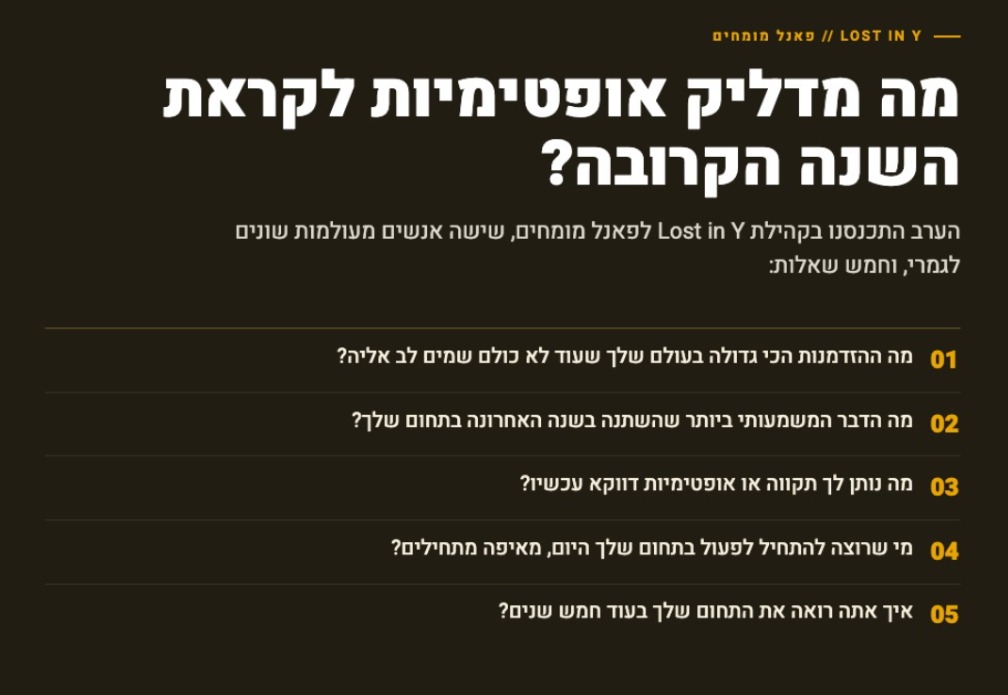
There's a difference between asking someone "how's work" and asking them "what do you see that nobody else sees yet." The first question gets you an update. The second gets you a map.
Heading into the new year, I ran a written panel in the community over WhatsApp. Six people, six completely different worlds, five identical questions:
- What's the biggest opportunity in your field that most people still haven't noticed?
- What's the most significant thing that changed in your field this past year?
- What gives you hope or optimism right now, specifically?
- If someone wanted to start working in your field today, where should they begin?
- How do you see your field five years from now?
Not to compare the speakers, but to see if there's a shared pattern underneath the surface.
Brains, cars, chips, the Negev, cancer, and pace
Dr. Muli Mandel, a psychologist and executive coach, opened with psychedelics. Not the trend itself, but the new ability to measure the brain and predict who will respond to which treatment, as psychedelics, biomarkers, and AI converge and turn psychiatry from trial-and-error into precision medicine. This year, he says, the field moved from initial hype to real maturity, more questions about mechanism and safety, fewer slogans. His optimism comes from the discovery of brain plasticity, and in five years he sees brain health becoming part of routine preventive care, the same way we treat heart health today.
Vered Mane, who runs Mitsubishi and ORA at Colmobil, brought the automotive angle. Her opportunity is the shift from reacting to what already happened, to anticipating and acting ahead of it, as cars, data, and AI converge. What changed this year, she says, is the pace, an unprecedented number of brands and models entering the market, and a good product is no longer enough. Anyone entering the field today, she says, needs to understand people, technology, and business all at once, and not be afraid to connect those worlds.
Avinoam Rozenbaum, head of staff at the Israel Innovation Authority, didn't talk about AI itself but about what enables it. Chips, power for data centers, cooling, and roughly 100 million shekels budgeted for national quantum-computing R&D infrastructure. The biggest change he identifies this year is the collapse of the "small global village" concept, supply chains that are no longer taken for granted, and countries reorganizing around technological independence. His optimism rests on three tangible things: a grassroots entrepreneurship renaissance growing out of reserve duty, a surge in defense tech, and a record year of $85 billion in exits, with Israel now the world's fifth-largest tech hub.
Fahima Atawna, the first resident of Hura to complete a master's degree at Columbia University, pointed to the human capital of young people in Bedouin society. A new generation with education and technological ability that wants not just to join the tech industry, but to found and lead it. Anyone wanting to start in her field, she says, needs to start on the ground, listening to young people themselves, and connecting programs that already exist but don't talk to each other. In five years she wants this to no longer be seen as an exception, but as an ordinary reality of entrepreneurs and leaders from the Negev.
Dr. Etgar Levy-Nissenbaum, a drug and medical-device developer, focused on oncology. The big breakthrough, he says, isn't just faster drug discovery, it's AI's ability to preemptively crack a tumor's resistance mechanisms and design multi-target drugs that attack cancer from several directions at once. This year, he says, the field moved from theoretical promise to real clinical results. He predicts that in five years cancer will stop being seen as a death sentence, and will mostly become a manageable chronic disease.
Yoav Harel, a senior technology-project manager at AT&T Israel, brought a different angle from the other five, not a specific field, but the dramatic drop in the cost of change itself. An idea used to require a heavy bet, budget, and development time. Today you can test many ideas in parallel, cheaply, learn fast, and try again. The deepest shift, he says, is in the roles themselves, the lines between managers, developers, and product people are blurring, and one person can now handle a far wider range of tasks.
The shared pattern
Six completely different fields, but one answer keeps coming back, phrased differently each time. Dr. Etgar Levy-Nissenbaum put it most directly: "there's no room to be an expert in a single segment without a spatial understanding of the whole field." Muli Mandel spoke about "between the disciplines, not inside just one of them." Vered Mane called it "connecting the worlds." This is exactly the "both/and" model this community is built on. Not one narrow specialty, but the ability to sit in the lab, understand the customer's pain, and speak the language of data in the same breath. The biggest opportunity is almost never inside one field, it's in the connection between two that haven't talked to each other yet.
Which of you reads these six and recognizes a connection to your own field, not within your profession, but between it and something else entirely? Write to me, I'd love to connect.